Inventory No. OS-7917
Availability
Available now. Contact us to reserve this item.
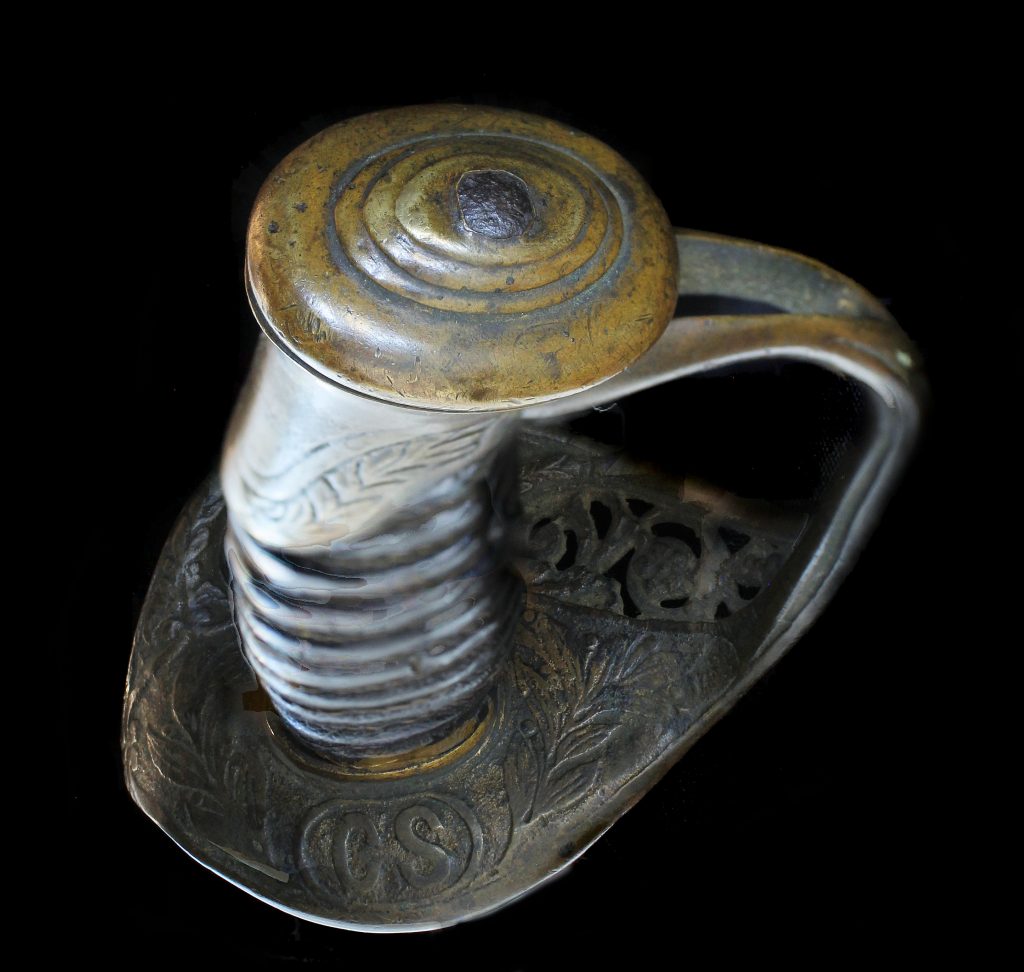
Since at least 1960, when William Albaugh published Confederate Edged Weapons, the sword pattern shown here has been identified as a Leech & Rigdon product. Mr. Albaugh does not say how he came to that conclusion, but I am sure he had his reasons. However, he was mistaken.
Some years ago, I owned one of the so-called “Leech & Rigdon” swords that was marked “L. Bissonet Maker Mobile Ala.” Since that time, I have examined several more with the same marking. I also spoke with Bill Beard, Kent Wall, and other sword collectors, including some of the most knowledgeable students and authors on Leech & Rigdon/Memphis Novelty Works of the last thirty years, about how the pattern under discussion came to be known as a Leech & Rigdon product. All, without exception, traced the attribution back to William Albaugh’s writings. Not one of these men had ever seen this pattern marked Leech & Rigdon.
In the process of studying this matter, I sparked an interest among other dealers and collectors and have since been presented with multiple additional examples marked by Bissonet.
It had long been noted that Leech & Rigdon swords bore Bissonet’s distinctive etching, but no one ever knew how that came about. While it was common for one dealer to sell another’s product, there is no chance that a broker would etch the word “maker” on another maker’s sword, though they would at times etch “etched by” on another maker’s sword. In short, there are numerous known swords of this pattern etched with the declaration that L. Bissonet was the “maker,” and there is no evidence that the pattern was a Leech & Rigdon product.
The example shown here is etched “L. Bissonet Maker Mobile Ala.” in three lines, accompanied by Bissonet’s elaborate foliate pattern interspersed with geometric designs. It also has a 6½-inch presentation panel bearing the name “L. D. Remey.” “Remey” is a misspelling. The man was Mobile, Alabama, merchant Lucious Deyampart Ramey. Ramey was born in Abbeville District, South Carolina, on August 3, 1824. At 25 years old, he moved to Marion, Alabama, to take a position as overseer on Mr. De Yampert’s plantation. Later, he moved to Mobile to work for wholesale grocers Messrs. Webb and Smith. From there, he went into the sawmill business in Citronelle, Mobile County, Alabama, in 1858, which he continued for the rest of his life, with the exception of the war years.¹
Ramey was living in the northern division of Mobile, Alabama, when Lincoln invaded the South. He was already 37 years old, but on April 4, 1862, he enlisted in Company F, 43rd Alabama Infantry, and was elected second lieutenant on April 15.² The 43rd was organized by Colonel Archibald Gracie and served in the western campaigns, including the Kentucky Campaign, the Battles of Perryville and Chickamauga, the Knoxville Campaign, and the Battle of Bean’s Station, before going into winter quarters.
In the spring, Gracie’s Brigade was transferred to Virginia and placed in Johnson’s Division of Anderson’s Corps in the Army of Northern Virginia. Lieutenant Ramey faithfully served for more than two years before requesting a transfer to the Department of the Gulf on April 15, 1864, due to wounds³ that left him unable to keep up with his company in the field. After receiving authorization to do so, he offered his resignation on May 3, 1864.⁴
However, before he left Virginia, Lieutenant Ramey was wounded and entered Richmond’s Chimborazo Hospital on May 16, 1864.⁵ After a month’s recuperation, the hospital granted him a 60-day furlough on June 16, 1864. Ramey suffered from consumption, ⁶ and I do not believe he returned to active duty. He passed away in Washington County, Alabama, on August 16, 1903.⁷ Lieutenant Ramey is buried in Pine Crest Cemetery, Citronelle, Alabama.
Ramey’s sword is in very good condition. The sword is still sheathed in its original brass mounted leather scabbard, which is in excellent condition. I have a distinct memory that when I purchased this sword several years ago, I saw a minor repair, but I’ll be darn if I can locate it now. Perhaps because of different light? Leather shrinks with time so the upper mount has been moved up; this is common, but usually no one tells you it has been done. The blade is semi bright and the etching is easily visible, with the exception of some of darker patches. It might clean to nearly bright, but the sword is so untouched that I am hesitant to do anything to it. The blade is nick free and has never been repointed. There is just a slight bit of movement in the hilt. The original leather grip and twisted copper wire are first class.
The sword is important historically for two reason, one it belonged to a line officer in a hard fought Alabama regiment and two, because its presentation will expose to the audience outside of the dealer world that these are not Leech & Rigdon swords.
| Inventory No. | OS-7917 |
|---|