Inventory No. OS-8032
Availability
Available now. Contact us to reserve this item.
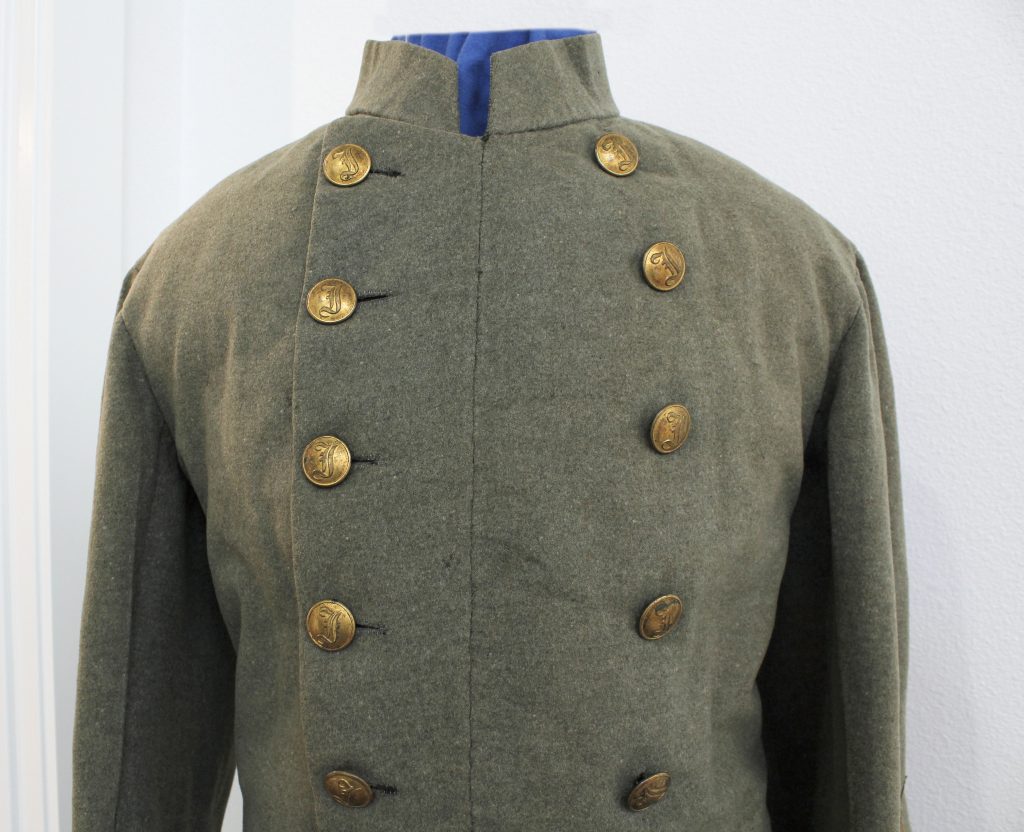
This beautifully tailored uniform consists of both the double-breasted frock coat and the matching trousers of a fine gray woolen broadcloth with infantry blue trim.
Curator Les Jensen had already written an examination report on these and recorded their history, so rather than re-inventing the wheel I am pasting his report below.
The script buttons, the sleeve braid, combined with the blue piping indicate that this was worn by a Major, Lt. Colonel or Colonel of Mississippi Infantry. Its condition is stellar; it is nothing short of miraculous that it has remained in this condition for 165 years. The details are recorded below. The sash shown in the pictures is post war; it and the mannequin that it is mounted on comes with the group at no charge.
[i]This beautifully tailored uniform consists of a full-length, double-breasted frock coat and matching trousers of a green/gray woolen broadcloth in a tabby weave. The weave appears to be about 60 threads per inch in both the warp and the weft. The warp looks to be very fine brown cotton with a gray woolen weft. The finely made, obviously expensive cloth is light in weight but holds its shape well and does not wrinkle. The coat has a 6-piece body consisting of two front panels, two side back panels, and two central back panels with a center seam. There are seven coat-size Confederate script “I” buttons on each side of the breast, conforming to Confederate regulations. The CS-177-A buttons bear the backmark “S. ISAACS CAMPBELL & CO 71 JERMYN ST LONDON”. The button holes are conventional in style and type, being hand-sewn with black thread over a larger brownish thread around the edge of the button hole. The standing 1 5/8” collar is made of two pieces and lined with the same material as the coat.
There is no indication that the collar ever had any type of insignia attached. The 2-piece sleeves measure 5 1/4″ across at the cuff and 9 1/4″ across at the elbow. There are no colored facings on the non-functional cuffs. Each cuff has three small 14mm Confederate script “I” buttons, bearing the backmark “TREBEL RICH STANDARD” and identified as CS-177-Av. Each sleeve bears three strands of gold bullion “Austrian knots”, which is regulation for a Major, Lieutenant Colonel, or Colonel.[ii]This large, flamboyant insignia extends 15 3/8” up the sleeve from the edge of the cuff. The skirt of the coat is of conventional frock coat form and originally had four coat-size buttons, similar to those on the front. The two upper buttons are missing, but the two on the ends of the pocket flaps remain present. There are pocket bags on the inside of the skirts under the lining made of dark brown, lightly glazed cotton. The frock coat is lined in the button falls with the same material utilized for the coat. The upper body is lined in a dark blue, tabby weave wool flannel. There is a 6 1/4″ x 7” patch pocket at the left breast made of the same material as the blue lining. The entire skirt is lined in what appears to be a very fine greenish brown cotton material. The sleeves are lined with a coarse light brown cotton twill. The front of the coat measures 17 1/8” from the bottom of the collar to the waist seam. The back of the coat measures 19 1/2″ from the bottom of the collar to the waist seam. The skirt is 21” long in the front and 3/8” longer in the back.
Accompanying this fine coat is a matching set of trousers of the same material with an adjustment belt in the rear and a Japanned buckle marked “PATENT 1855”. The fly consists of two layers of trouser material lined with dark brown cotton that is closed by means of four black Japanned metal buttons measuring 13mm. The waistband closes with a single button of similar form but measuring 17mm. Perhaps the most important button on the uniform is an inside Japanned metal button for inside closure of the fly to maintain a flat appearance. This 14mm button is clearly marked “WM. POOLEY. MEMPHIS TENN.” The pants are lined with a light-colored cotton twill, and the material appears the same on the pocket bags. The trousers have side slit pockets in line with the dark blue velvet-piped seam. This uniform was originally found at a yard sale near Dallas, TX, in the 1970s, and at one time was accompanied by a white cotton vest with Mississippi “I” buttons. The William Pooley button indicates that he was the tailor who made the uniform in Memphis, TN, and we can assume, because of the aforementioned vest, that it was for a Mississippi officer of a rank from Major to Colonel. All buttons, whether script “I” buttons[iii] or black Japanned pants buttons, are original to the coat and further reinforce the assumption that William Pooley created this exceptional uniform. Since Memphis fell to Federal forces in June of 1862, it is quite likely the uniform was made during the first year of hostilities. William Pooley died on August 27th, 1861.[iv]
[i] Recognized authority, Les Jensen report dated April 20, 2020. Comes with the uniform [ii] Confederate Regulations of 1861, trim color and numbed of strands of braid. [iii] In my opinion they have been resewn, leaving doubt about this. [iv] Elmwood Cemetery Biographical Sketches 1874 Pooley Brothers:
On lot no. 179, Fowler Section, located in the north-east portion of Elmwood Cemetery, and on the north side of the Road of Honor, are buried two brothers, William and James Pooley, and their brother-in-law, Robert Purdy. All these were natives of Scotland. William Pooley and Robert Purdy came to Memphis in 1854, as merchant tailors. James Pooley settled in Memphis in 1858, as a jeweler. He established the jewelry store now occupied by F.D. Barnum-his brother-in-law and successor. They were steady and skillful men in their respective vocations, and being prosperous in business, purchased country homes in the vicinity of the city. All three, in succession, received fatal injuries by being thrown from a buggy while returning home from business after dark. To make this remarkable coincidence the more singular, the horse or horses (for they were different) on each occasion took fright and ran off just outside of the old entrenchments. The following are the dates of these casualties–the first two being in close proximity of time: Robert Purdy was thrown April 31st, and died may 1st, 1861. William Pooley was thrown July 15th, and died August 27th, 1861. James Pooley was thrown March 25th, 1865, and was killed instantly.
| Inventory No. | OS-8032 |
|---|